
Pas de Deux
"Pas de Deux" by Jamie Cattanach
Issue 3.8 | Nonfiction
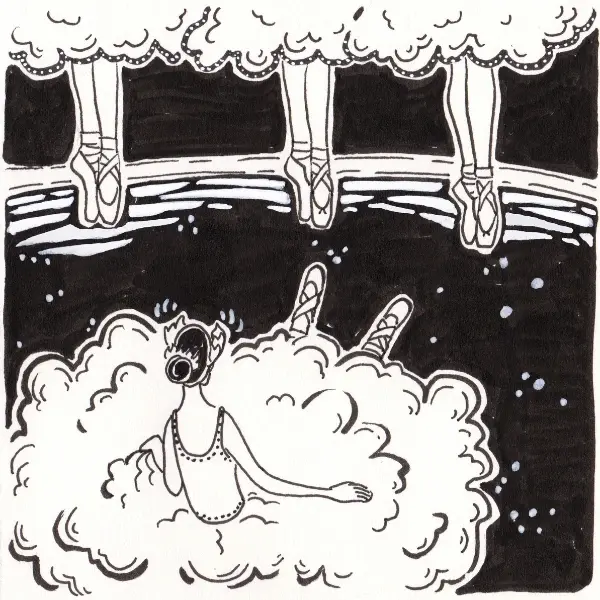
What it must have meant, to my father, to bring his daughter to the ballet. After his childhood. After finding his parents drunk-dead on the kitchen floor. After the pedestrian white-trash poverty he turned around, new money a kind of passing, not passing. The Trumpian understanding of wealth: gold and gold, well-done steak. So well you could walk on it, he would say when he ordered.
This specific ballet, hyperpalatable, unchallenging, with its idealized family holiday frivolity so white and wealthy and heterosexually coded. The kind of party where children dance boy-girl cotillion alongside their adult counterparts, learning the steps, learning to make more; where the Tennenbaum tree grows big, bigger. The girls cradle their dolls and the boys will be boys until their fathers, remembering boyhood, swoop in to yank them. The kind of party where the delicate-boned woman of the house directs a maid to pick up a hobby horse discarded. Where the nutcracker has its own miniscule bed.
How worthwhile to be here; how I start crying as soon as the orchestra begins—my father’s favorite. The game I fashioned when I was young, to impress him, picking out specific instruments in a track: French horn. Oboe. My father who started his first band at fourteen, who was making it before he gave it up for the security of real money, mouth-feeding. Today, I can’t tell brass and woodwind apart.
How worthwhile and obnoxious to be here in the red-trimmed theater, with the man behind me wetly clearing his throat and everyone sniffling their winter colds and the impatient children all shushed, shushed. How this, the great gross moving glut of humanity, is part of the point of it. Its fulcrum.
This on the day I babysat my friend’s four-year-old son as she slid under twilight anesthesia, a doctor needle-sucking from her his potential future sibling. To be here at this ballet alone, tucked up in Box One, crying over the ledge at the orchestra, thirty-six and gray enough to show it. Are you joining a party? the usher asked; I’m so used to it now, prefer it even, though probably no one thinks so when I say no, just me. The choice I am making, not to enter. The frenetic mothers at intermission saying we probably won’t stay for the second act, their children having slept or cried or fidgeted through the first. To see the tragedy of it even in my relief; to look down onto a stage and understand the desire to show this to someone. To know, as the dancers sweep across the stage—perhaps dreading a hard step or thinking about their dinner—that they will outlive me, were born on days I could remember, if pressed.
The long bathroom lines of red sweaters and green velvet and glitter. The no because—primarily because—I’m an artist, too. Want words more. The artists below, the orchestra musicians, the keyboardist sitting cross-armed back in her chair waiting for her part like a city bus. The stage lights sparkling the paper confetti snowflakes fluttering down over the sleeping girl’s bed, the dance of the snowflakes I remember saying was my favorite, holding my father’s hand, all of it my favorite.
Here on this day when some nurse helped my friend up off the gurney and 39 eggs! she texts me and my lover on the other side of the country with his mother. Family, he says, like a spell I do not understand, the great long shadow of family and me here so happy and relieved to be alone. You’d be so good at it, he says, making that face I never make at the children we see in public. I’m open, I tell him, to changing my mind.
Out on the other end of the country but sitting here, I have told the people who asked, for my father, a man I would not speak to for the entire last decade of his life, not really, pressing a few nothing-words into the phone for five minutes on my mother’s insistence after our—real—conversation. Here at the other corner of the continent where I came wanting gone from him, from his drink and his Fox News and the Confederate flag he asked me to hang for him in the backyard bar he had built by brown people, wanting gone from this ballet-family-fantasy into which I played, was. Here on the other side of the country, trying, with some success, to be something totally different—and yet, when the orchestra takes up its instruments and the conductor coils and springs as if his whole body were the thick book of the score and they play, to align themselves, all forty of them, a single reverberating note, I start crying the way my parents did so often when we were out, the two of them and me, their last-minute only child, and their bad wine and my Shirley Temple and Les Paul in a New York City basement or some nobody at the golf club a mile from our South Florida home and they would look at each other wellingly and say that single-word sentence, Talent.
I cannot run away from that I am them, here in this place where I later learned a valley bears my grandmother’s maiden name, where four generations ago some segment of my family came before me, enacted their ordinary historical violence, killed. No place runaway, no place anonymous, no place outside of the sight of fate or, if you like to call it so, god. I bring him here, my body leaned forward in the seat, my bottle of water in place of his plastic sippy cup of intermission wine; I bring him here, his failed artist’s heart my own. The way we lean close when we see it, the people who are doing it, who have to, this thing that happens every year and every night and also only exactly this once. I bring him here again.
—
Jamie Cattanach's writing has been featured in major media outlets including The New York Times, CNBC, USA Today and HuffPost as well as literary journals including Colorado Review, Buckman Journal and Fourth Genre, which nominated her essay, "Dessert," for a 2025 Pushcart Prize. Her work has also been shortlisted for the 2025 Disquiet Literary Prize and chosen for the 2022 Tin House Winter Workshop manuscript mentorship program.
Comments